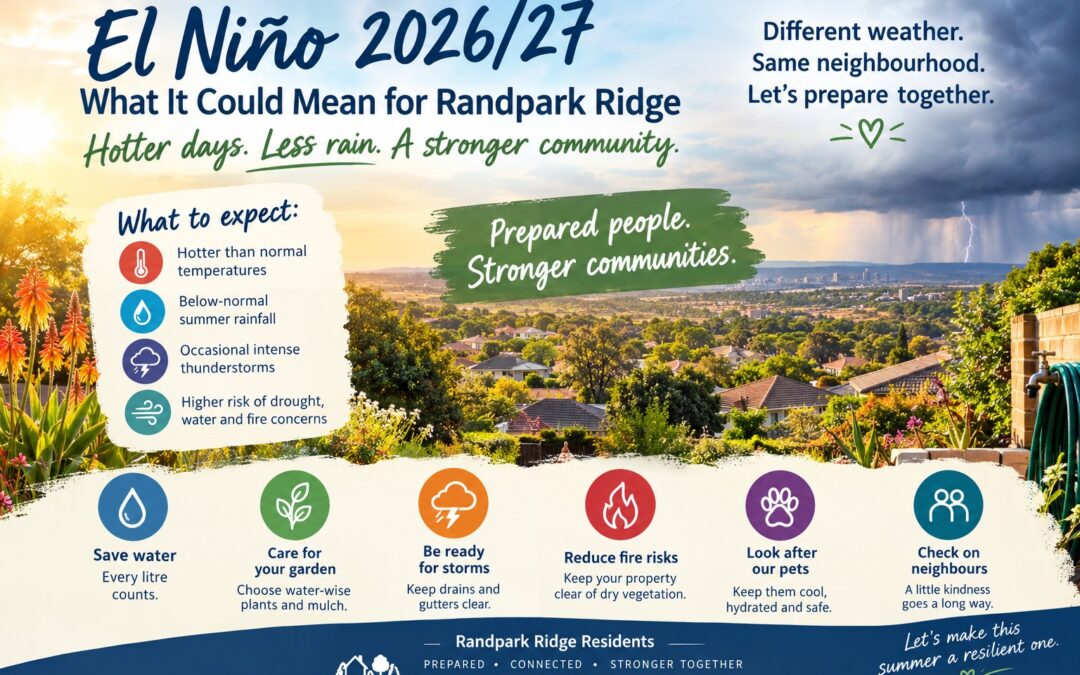
A warmer, drier summer may be on the way – but as a community, we can prepare
Summer in Randpark Ridge usually means thunderstorms rolling across the Johannesburg skyline, lush gardens, afternoon rain, and the familiar sound of raindrops on the roof.
This summer, however, residents may notice that the weather feels a little different.
Weather and climate authorities are warning that a strong to very strong El Niño event is developing and is expected to influence weather patterns through the 2026/27 summer season. The World Meteorological Organization (WMO) says El Niño is already firmly established and is expected to strengthen further into a very strong event, with the potential to significantly influence global weather patterns. There is an almost 100% probability that El Niño conditions will continue into early 2027.
For South Africa, that matters.
Latest forecasts point towards above-normal temperatures and below-normal rainfall across large parts of the country’s summer-rainfall region.
First Things First: What Exactly Is El Niño?
El Niño is a natural climate pattern caused by unusually warm ocean temperatures in parts of the tropical Pacific Ocean.
Although it occurs thousands of kilometres away, it can influence weather around the world, including South Africa, where it is often associated with hotter and drier summer conditions.
However, there is an important point to remember:
El Niño does not mean that it will never rain.
Even during El Niño years, South Africa can still experience thunderstorms, heavy rainfall events and localised flooding. El Niño simply increases the likelihood of hotter temperatures, less rainfall overall and longer dry spells.
So rather than expecting a completely dry summer, it is more realistic to prepare for a warmer season with less rainfall overall, while still being ready for occasional severe storms.
What Are Forecasters Expecting for Summer 2026/27?
Recent forecasts from international and South African climate agencies all point in a similar direction.
The WMO expects El Niño to continue through the summer season and into early 2027.
South African forecasts indicate an increased likelihood of:
- Above-normal temperatures
- Below-normal rainfall
- Increased risk of heatwaves
- Increased potential for water stress across parts of the country.
While no long-range forecast can predict the weather on a particular street or day, the overall message is clear:
The odds are tilted towards a hotter and drier summer.
What Could This Mean for Randpark Ridge?
🌡️ Hotter Days
Residents should prepare for periods of above-normal temperatures, particularly as spring transitions into summer.
This may mean:
- Hotter afternoons
- Greater heat stress for elderly residents and young children
- Increased water requirements for gardens
- Greater stress on lawns, plants and trees
- Higher electricity demand for cooling
- Greater risk of dehydration for people and pets
- For those spending time outdoors, adjusting activities away from the hottest parts of the day may be worthwhile.
💧 Water May Become Even More Precious
Our leafy streets and mature gardens make Randpark Ridge unique, but hotter days and less rain put real pressure on household and municipal water supplies.
Simple Steps Everyone Can Take
- Water gardens early morning or late afternoon.
- Avoid watering during peak heat.
- Fix leaking taps and check irrigation systems.
- Use mulch to retain soil moisture.
- Plant indigenous, water‑wise species.
- Collect rainwater where possible.
- Reuse suitable greywater responsibly.
Don’t wait for restrictions before becoming water-wise.
🌱 Our Gardens May Need Some Extra Care
Our gardens are one of the things that make Randpark Ridge special.
Unfortunately, prolonged heat and dry conditions can place additional stress on plants.
Residents may notice:
- Lawns turning brown
- Increased wilting
- Heat stress in trees
- Dry soil conditions
- Increased watering requirements
- Greater susceptibility to pests
A brown lawn is not necessarily a dead lawn.
Allowing grass to become dormant during dry periods is often far more sustainable than using large quantities of water to keep it green.
⛈️ Don't Put the Storm Drains Away Just Yet
Drier overall does not necessarily mean storm-free.
That means residents should prepare for both extremes.
Before summer arrives:
- Clear leaves and debris from drains and stormwater channels.
- Check gutters and downpipes.
- Ensure water can flow away from buildings.
- Secure outdoor furniture and umbrellas.
- Check trees for damaged branches.
- Inspect outdoor electrical equipment and pool areas.
🔥 Fire Risk Could Become More Important
Hotter and drier conditions increase the amount of dry vegetation around homes and public spaces.
Residents should:
- Keep gardens maintained.
- Remove excessive dry vegetation.
- Avoid allowing garden waste to accumulate.
- Keep combustible materials away from buildings.
- Review emergency procedures with family members.
Preparedness isn’t about fear. It’s about reducing risk, protecting what matters, and helping our community remain resilient no matter what the season brings.
🐾 Don't Forget Our Four-Legged Residents
Heat affects pets too.
On particularly hot days:
- Ensure pets have access to fresh water.
- Provide adequate shade.
- Avoid walking during the hottest hours.
- Be mindful of hot paving surfaces.
- Never leave animals in vehicles.
- Watch for signs of heat stress.
Our pets rely on us to recognise when conditions become uncomfortable or dangerous
🌿 Let's Make This a Summer of Community Resilience
Whether summer brings dry weeks, spectacular thunderstorms, or a little of both, the strength of Randpark Ridge has never been the weather.
It has always been the people who call it home.
If each household uses water responsibly, prepares its property, checks in on neighbours and supports community efforts, we will be far better positioned to handle whatever the season brings.
Climate forecasts describe probabilities, not certainties. What current forecasts do tell us is that a hotter and drier summer is more likely than normal, making sensible preparation worthwhile.
So let’s respond the Randpark Ridge way:
With preparation, responsibility and community spirit.
🌿 Let’s stay cool.
💧 Let’s save water.
🌳 Let’s care for our environment.
❤️ Let’s look after one another.
Because a resilient community isn’t one that avoids every challenge.
It’s one that faces challenges together.
Prepared. Connected. Resilient.
Weather and climate forecasts can change as new information becomes available. Residents should continue to follow updates and warnings issued by the South African Weather Service (SAWS).